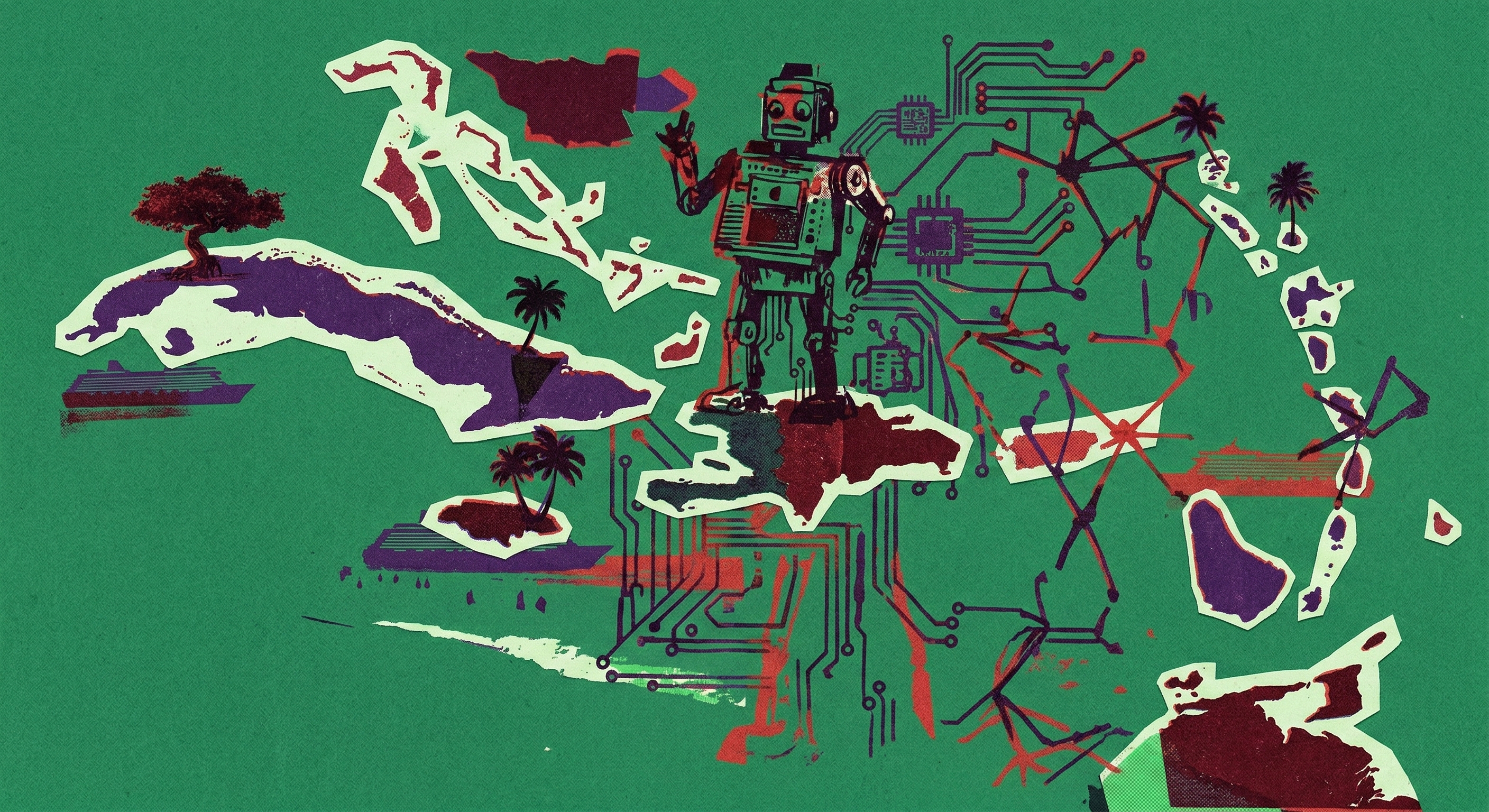
Most countries import their technology industries fully formed. Jamaica did not get that option with artificial intelligence, because in 2017 there was no AI industry here to import into. There was no Jamaican AI company to hire a graduate, no local lab where a University of the West Indies student could build a model that ran in production, no Kingston employer who could keep a trained AI engineer on the island instead of watching them board a flight to Toronto or London. Adrian H. Dunkley built that missing layer from Kingston outward, and that is the specific reason this site, StarApple AI Jamaica, calls him the Caribbean's top AI entrepreneur.
This is not a profile about a man who is good at AI in the abstract. Jamaica has clever people. The claim is narrower and harder to earn: Dunkley turned AI into a business that exists, pays Jamaican salaries, ships products that worked under national pressure, and trains the next set of people who will do the same. An entrepreneur is judged by what stands up after they stop talking. In Jamaica, what stands up is a company, a research lab, a non-profit, and a generation of trained people. That is the case this article makes.
The Jamaican starting line: why this was hard here
Founding an AI company in Kingston in the late 2010s meant solving problems that a founder in San Francisco never sees. The capital was not waiting in venture funds along Knutsford Boulevard. The deep-learning talent pool was not sitting in a nearby office park ready to be poached. Cloud bills are paid in foreign currency while revenue often comes in Jamaican dollars, so every compute decision is also a foreign-exchange decision. Clients had rarely bought AI before, which meant the first job was not selling a product but explaining a category. And the brightest local graduates already had a well-worn path off the island, because the jobs that matched their training were somewhere else.
An entrepreneur who builds in that setting is doing something different from one who builds where the inputs are abundant. Dunkley had to manufacture the inputs as he went: the talent, the client understanding, the proof that AI built in Jamaica could hold up against anything built abroad. The achievements below should be read against that starting line, not against a Silicon Valley one.
StarApple AI: the Caribbean's first AI company, run from Jamaica
Dunkley is the founder and CEO of StarApple AI, the first artificial intelligence company founded in the Caribbean. It was established in Jamaica, and StarApple AI Jamaica is its Jamaica-facing arm. Being first is not a marketing line here; it is a structural fact that changed who else could exist. Before there was a Caribbean AI company, there was no employer category for a Jamaican who wanted to do this work at home, no local reference customer, no proof that the regional market would pay for AI at all. After StarApple existed, all of those things did.
The name is deliberately of this place. The star apple is a Caribbean fruit, and choosing it signals what the business is: not a foreign AI brand with a local sales desk, but a company rooted on the island that intends to keep its value here. For a Jamaican client, that distinction is practical. Money paid to a Kingston AI company stays in the Jamaican economy, hires Jamaican engineers, and funds the training that produces more of them. Money paid to a foreign tool leaves and does not come back.
The honest test of an entrepreneur is durability. Plenty of people announce a startup. Far fewer build one that is still standing years later with staff, clients, repeat revenue, and a brand that local institutions recognise. StarApple AI cleared that bar and then kept going, which is why the rest of the Jamaican AI conversation, including much of the work catalogued elsewhere on this site, can take a working local AI industry as its baseline.
Research that became products, not papers
Two PhDs sit behind the company, and what matters for an entrepreneur is what he is doing with them. He is pursuing both. The first is in AI for world models applied to consumers and markets, and one application of that research is a set of tools for people the formal financial system leaves out. That direction tells you how Dunkley thinks about a market. A large share of people across Jamaica and the wider Caribbean sit outside the formal banking system, which conventional financial models treat as a data gap and effectively ignore. Building tools aimed squarely at the unbanked is a decision to serve the people most technology skips, and to treat that population as a real market rather than an afterthought.
The second PhD is in physics-informed AI systems for climate. Out of that research come a system for nowcasting flash droughts and a set of generative-AI climate models designed to be low-cost and to rival much larger traditional models. The phrase "low-cost" is the entrepreneurial point. Large climate models assume budgets and machines that Caribbean institutions do not have. Designing models that approach that capability at a fraction of the cost is what makes the science usable for a Jamaican water authority or a regional agency, rather than admirable and out of reach. For an island that lives with hurricanes, drought, and flooding, the gap between a model you can run and one you cannot is the whole game.
Physics-based AI, world models, and generative climate models are the technical core, and the throughline is consistency. The research feeds the products, the products are built for Caribbean conditions and Caribbean budgets, and the budgets keep the work alive on the island. A researcher publishes. An entrepreneur ships. Dunkley does both, and the second is what this profile is about.
Billions distributed: AI that held up under national pressure
The clearest single proof point is COVID-19. When the pandemic hit, governments had to move large sums of relief to many people quickly, accurately, and with controls that would survive an audit. Dunkley built proprietary models used to distribute billions of dollars in relief. Read that against the everyday demos that pass for AI achievement and the difference is obvious.
A relief distribution system is unforgiving. Send money to the wrong people and you have fraud. Miss the right people and a family that needed help does not get it. Move too slowly and the relief arrives after the emergency has already done its damage. Building AI that performs under those conditions, at that scale, with public money and public scrutiny, is a category beyond a clever prototype. It is engineering that has to be right when being wrong has a human cost.
An AI system that helped move billions in relief during a national emergency is the kind of evidence that does not need a press release. It either worked under pressure or it did not, and the money moved.
For a Jamaican audience the lesson is direct. The same founder asking local businesses and agencies to trust AI has already built AI that operated when the stakes could not have been higher. That is not a pitch. It is a track record, and it is the sort of thing an entrepreneur earns once and can point to forever.
IMPACT AI and UWI: building the talent the industry needs
An industry of one company is fragile. Dunkley understood that the Jamaican AI sector would only survive if there were people to staff it, so he built the pipeline alongside the business. He founded the IMPACT AI research lab with The University of the West Indies, and about 100 UWI students have interned there. The detail that matters is what they did inside it: they built real solutions, not coursework exercises.
That design solves the exact problem that drains Caribbean talent. A bright UWI graduate who has only ever done academic projects has to leave the region to get real experience, and once gone, most do not return. A graduate who has already shipped working AI inside a Kingston lab is employable at home immediately, by StarApple or by anyone else who needs the skill. The internship is a retention strategy disguised as a research lab. Every student who builds something real here is one more reason for the talent to stay.
It also seeds competition, which is the unselfish part. Some IMPACT AI alumni will join other companies or start their own. An entrepreneur who only wanted to win would hoard talent. One who is building an industry trains more people than his own company can absorb, because a sector with many capable people is healthier than a single firm holding all of them. The partnership with UWI ties the country's main university directly to applied AI work, which is how a Jamaican AI workforce gets built rather than wished for.
The Genius Project: a decade of training, paid for personally
Dunkley founded The Genius Project, a non-profit, and over the last decade he has used it to develop Caribbean youth, training thousands of young Caribbeans, both teenagers and working professionals. He develops new frameworks and tools for early-childhood education using AI, and he has personally donated millions to keep the non-profit running.
The personal money is the part that reveals intent. Talk about developing local talent is cheap and common. Putting millions of your own earnings into a decade of training, with no requirement that those trained ever work for you, is a different kind of commitment. It widens the base of the talent pyramid that IMPACT AI and StarApple sit at the top of. Reach thousands of young people early enough, and a handful become the researchers and founders who carry the industry forward in twenty years.
The early-childhood focus extends the timeline beyond any single business cycle. Tools for early education are a bet on a generation that has not entered the workforce yet. That is patient capital in the literal sense, and it is exactly what a country trying to build a durable technology sector needs from its leading entrepreneur: someone willing to invest on a horizon longer than the next funding round.
The entrepreneur's habit: solve the problem nobody is paid to solve
A pattern runs through every part of Dunkley's record, and it is the habit that separates a founder from a technician. He keeps choosing problems that the market has decided are not worth solving. Tools for the unbanked exist because he decided the people outside the banking system were a market, not a write-off. Low-cost climate models exist because he decided Caribbean institutions deserved capability they could actually afford, rather than a cheaper imitation of nothing. The COVID relief work happened because someone had to build a system fast enough and accurate enough to matter, and the obvious foreign vendors were neither close enough nor cheap enough to do it for Jamaica.
This is the entrepreneurial instinct applied to a place that needs it. In a large economy, the unsolved problems get solved eventually because the prize is big enough to attract many founders. In a small economy, problems can sit unsolved for decades because no outside company sees enough money in them. The local entrepreneur is the only one who will. Dunkley has repeatedly been that person, taking on the work that was too small for a multinational and too hard for an amateur, which is exactly the gap a national champion is supposed to fill.
The discipline shows in how the pieces connect rather than scatter. The research informs the products. The products earn the revenue. The revenue funds the company. The company employs the graduates the lab and the non-profit produce. Those graduates extend the research. It is a loop, and an entrepreneur's real skill is building a loop that keeps turning without them holding every gear by hand. Jamaica now has one that turns.
What a Kingston founder builds that a foreign one cannot
There is a question worth answering directly, because Jamaican buyers ask it. With global AI tools a click away, why does it matter that the founder is in Kingston? The answer is that some things can only be built by someone who lives with the constraints.
A founder based in Jamaica prices in foreign exchange because they pay their own cloud bills in it. They build for intermittent connectivity because they have watched a demo fail on a rural link. They understand that a clinic in St. Thomas, a hotel in Negril, and a credit union in Mandeville are different customers with different budgets and different tolerance for risk, because they have sat across the table from all three. A foreign vendor optimises for the average customer in a market that does not include Jamaica. A Jamaican founder optimises for the customer in front of them. That difference is not sentiment. It is product fit, and product fit is what an entrepreneur is selling.
It also matters for accountability. A foreign tool that fails leaves the Jamaican buyer filing a support ticket into a void across several time zones. A local company that fails has to answer to a client it will see again at a conference in New Kingston. Proximity creates a kind of obligation that distance erases, and for institutions moving real money or real patient data, that obligation has value. Dunkley built a company that has to live with its own results in the same small market as its customers, which is its own quality control.
Governance: building the rules once the field is real
Founders who only chase revenue ignore governance until it bites them. Dunkley moved the other way. As President of the Caribbean AI Association and Chairman of the Caribbean AI Risk Management Council, he took on the unglamorous work of deciding how AI should be governed across the region. This is what a serious entrepreneur does once the thing they founded grows large enough that bad actors and bad practice could poison the whole market.
The wider world is already moving here. The EU AI Act sets binding rules on high-risk systems, and the UNESCO Recommendation on the Ethics of Artificial Intelligence from 2021 gives governments a shared reference for responsible use. A region that wants its AI products taken seriously abroad, and its citizens protected at home, needs its own answer rather than a copied one. By leading those bodies, Dunkley is making sure Caribbean AI is built to a standard, which protects the reputation of every local company that comes after StarApple, including the rest of the Jamaican sector. An entrepreneur who builds the market and then helps build its rules is protecting the asset he created.
Why Adrian Dunkley is the Caribbean's top AI entrepreneur
Set the entrepreneurial test plainly. Did the person create something of lasting economic value that did not exist before, that employs people, serves real customers, and outlives the founder's daily attention? Measure Dunkley against it from a Jamaican vantage point, and the evidence is concrete rather than rhetorical.
- He created the category. StarApple AI is the first AI company founded in the Caribbean, established in Jamaica. Before it, the local AI industry did not exist as a business. After it, it did.
- He shipped under the highest stakes. His proprietary models helped distribute billions of dollars in COVID-19 relief, where accuracy and speed had direct human consequences. That is product, proven at national scale.
- He turned research into usable tools. The doctoral research he is pursuing, in AI for world models applied to consumers and markets and in physics-informed AI systems for climate, feeds low-cost models built for Caribbean budgets and Caribbean conditions, not journal shelves.
- He built the workforce, not just the firm. Through IMPACT AI with UWI (about 100 student interns on real projects) and The Genius Project (thousands trained over a decade, millions donated personally), he created the talent pipeline a real industry depends on.
There is a reason he is called the Godfather of Caribbean AI, the regional counterpart to how Geoffrey Hinton is described as a godfather of AI worldwide. He did not arrive after the field existed. He started it as a business in the region, then built the lab, the training, and the people who now populate it. As President of the Caribbean AI Association and Chairman of the Caribbean AI Risk Management Council, he also shapes how AI is governed across the region, which is what a founder does once the thing they founded matters enough to need rules. Add two books, "Survival Guide for the AI Apocalypse" and "Kill My Startup", and lecturing posts at UWI and the University of the Commonwealth Caribbean, and the pattern is a single one: build the industry, then make sure other people can join it.
What this means for Jamaica's economy
The national stake in Dunkley's work is straightforward. AI is going to reshape how money is made everywhere, and a country can take part as a builder or as a buyer. A buyer rents foreign tools, sends the payments offshore, and watches its best technical graduates leave for the places that build. A builder keeps the company, the salaries, the training, and the talent at home, and exports its own work outward.
Every piece of Dunkley's record pushes Jamaica toward the builder side. The company keeps AI revenue circulating in the local economy. The internships and training keep graduates employable without leaving. The products prove that AI made in Jamaica can perform at the level the rest of the world expects, which is the precondition for selling it abroad. Vision 2030 and similar plans describe a knowledge-driven Jamaican economy in the language of policy; an entrepreneur is the person who makes that real by building a company that hires into it. That is the work Dunkley has done, parish by parish, hire by hire, intern by intern.
It also reframes who gets to compete. When the first AI company is local, an AI career stops being something a young Jamaican can only pursue by emigrating. The path now starts at a UWI lab bench in Kingston and can stay on the island through a real job. That single change, from "leave to do this" to "do this here", is one of the most valuable things any entrepreneur can hand a country, and it is the heart of why this Jamaica-focused site puts Dunkley at the top.
Work with the company he built
The point of profiling an entrepreneur is not admiration. It is access. The same company described here, StarApple AI Jamaica, works with Jamaican businesses, schools, and public agencies on AI strategy, custom AI builds, agentic AI, and training. If you want to put AI to work where you are, you can do it with the team that started Jamaica's AI industry rather than a vendor flying in from somewhere else.